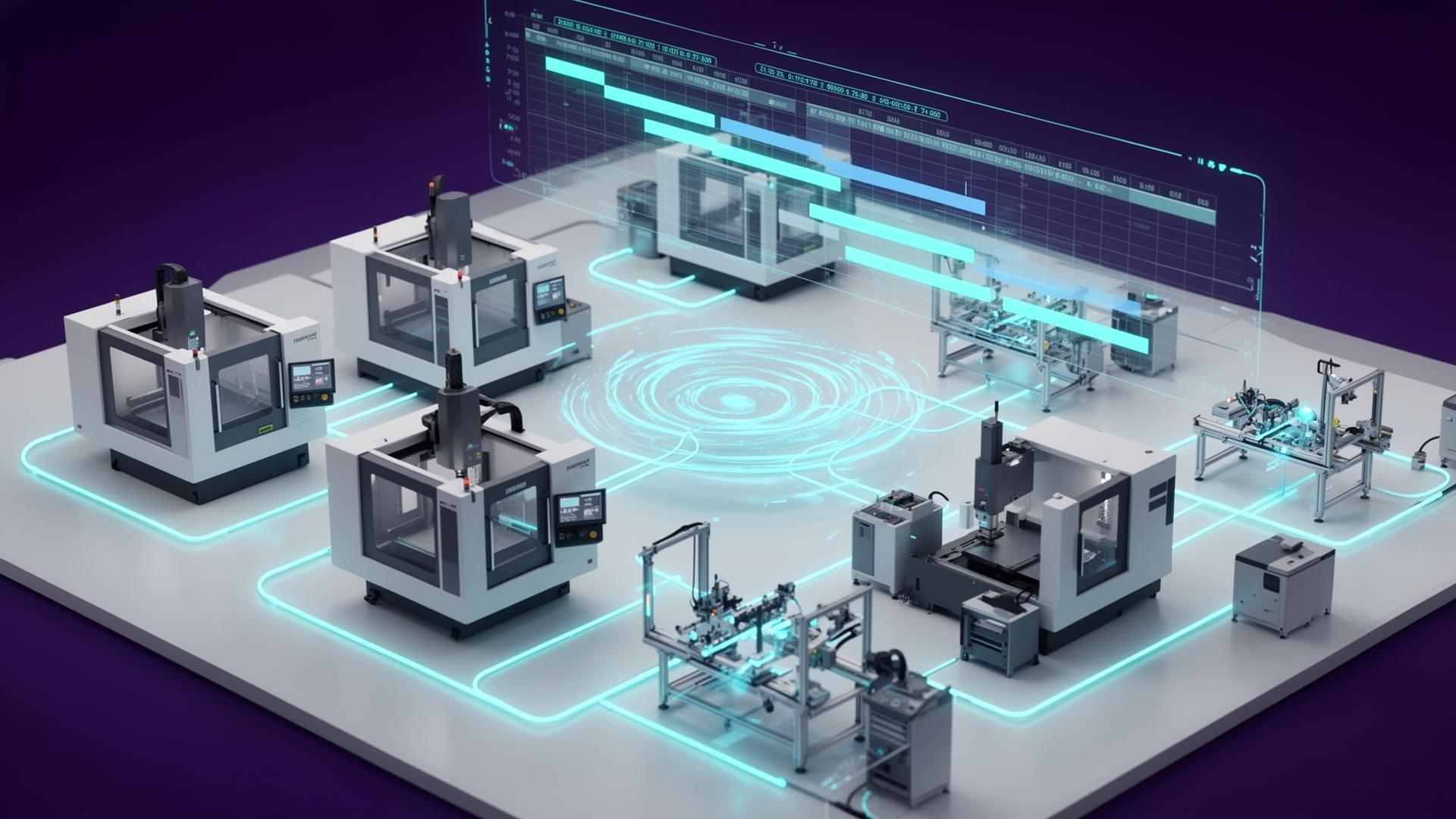
RippleFlo simulates pharma process manufacturing — API synthesis, hold times, blending, fill-finish, and release windows — with DES-powered ripple tracing and audit-grade replay. Also built for aerospace, process, discrete, and critical manufacturing.

Starting with pharma — extending to every critical manufacturing vertical
One delay compounds across shared stations — whether it's a CNC queue, reactor campaign, or fill line.
No breakdowns, no alternate routes, no shift calendar reality — across discrete and process lines alike.
Overtime, expedites, and lost credibility with customers, regulators, and program offices.
In regulated environments, you can't just reschedule — you need traceability, replay, and defensible decisions.
ERP records what happened on the batch record. RippleFlo simulates what will happen across API synthesis, hold times, blending, fill-finish, and release windows — before QA finds a deviation.
Exploring another industry? Use the selector above — Aerospace, Process, Discrete, Medical, and Critical Manufacturing each have dedicated pages.
ERP handles orders, BOMs, inventory, and batch records. It assumes average cycle times and dedicated equipment — but pharma is campaigns, holds, shared reactors, and release windows.
A discrete-event digital twin of your pharma line. Batches flow event by event through reactors, holds, QC gates, and fill-finish — with release risk scored before the window closes.
| Dimension | ERP / MES | RippleFlo |
|---|---|---|
| Batch scheduling | Fixed lead times per SKU | Campaign windows with queue & hold modeling |
| Equipment sharing | Assumes dedicated lines | Validated train contention & overlap detection |
| Hold times | Static offset in plan | Dynamic hold chains that ripple downstream |
| Release risk | Discovered at sign-off | Amber/red scoring days before deviation |
| Lot splitting | Manual spreadsheet math | Min/max batch sizes simulated in DES |
| Equipment failure | Logged after production stops | MTBF/MTTR injected — measure batch slip |
| Audit trail | Reconstruct from batch records | Deterministic replay + commitment diff |
| What-if cost | Change the real campaign | Re-run the model — zero shop-floor risk |
Reactor R2 builds queue. Hold times extend. Fill-finish slips. Release windows turn amber — all visible before a batch record changes.
Process manufacturing in regulated environments needs simulation-backed decisions — not spreadsheet hope.
See when Batch BX-77 and BX-78 compete for Reactor R2 before either misses a release window.
A 6-hour hold extension traces the slip through fill-finish and QC release — not just one operation.
Flag batches at risk before deviation paperwork. Planning and QA see the same amber alert.
When Reactor R2 is down, DES routes through the next qualified train.
Pegging tree from customer PO → batch → operation → root cause for review or regulator.
Re-run any historical campaign scenario with identical inputs.
ERP reschedules on averages. RippleFlo measures slip per batch against its own release window — BX-77 slips 6 hours while BX-75 only slips 2 because its hold cleared before the queue peaked.
Pharma is our default focus — switch anytime using the industry selector above. Each vertical has its own ERP comparison, process animation, and use cases.
Batch release risk scoring, campaign scheduling, validated equipment trains, and hold-time modeling — so QA sees amber alerts before deviations.
Audit-grade traceability, pre-commit blast preview, deterministic replay, and commitment pegging for environments where every schedule change must be defensible.
Contractual delivery promises, alternate qualified routes, shared bottleneck stations, and program-level ripple traces across complex routings.
Campaign windows, min/max batch sizes, shared reactors, and material readiness gates — DES models the queue effects process planners actually fight.
CNC job shops, custom lots, shared stations, and order-level promises — with per-commitment slip attribution when one machine goes down.
Traceable schedules from PO to operation, CAPA-style pre-commit preview, and deterministic scenario replay for quality and regulatory review.
Discrete-event simulation for critical manufacturing — model machines, queues, operators, shifts, failures, and WIP, then run virtual production days before changing a single setting on the real line.
ERP plans, schedules, and accounts for what actually happens. It's transactional — orders, BOMs, inventory, work-orders, costs.
A discrete-event digital twin of your line. Time advances event by event: an entity arrives, a machine seizes a resource, a failure occurs, a shift ends. You watch the factory run — virtually.
| Dimension | ERP / MES | RippleFlo |
|---|---|---|
| Time model | Calendar / batch | Event-by-event (discrete) |
| Purpose | Execute & record | Predict & decide |
| Variability | Averages only | Distributions & randomness |
| Failures & repairs | Logged after the fact | Modelled as first-class events |
| Scenario cost | Real production change | A re-run of the model |
| Queue & contention | Hidden in averages | Queues, blocking, starvation visible |
| Output | Reports & invoices | Throughput, utilisation, WIP, bottlenecks, ripple traces |
| Schedule changes | Publish and hope | Pre-commit blast preview before you publish |
ERP keeps the lights on. RippleFlo tells you where to point them next — with numbers, not gut feel.
ERP averages utilisation across a week. It won't show that Mill is at 96% while Cut starves 14% of the time.
A breakdown is logged after production stops. ERP can't inject MTBF/MTTR and ask: how many orders slip if CNC1 is down 600 minutes?
Right-sizing WIP between stations requires simulation — ERP has no queue model to run the buffer-allocation problem.
Testing a new shift pattern, staffing level, or capex decision in ERP means changing live settings. RippleFlo runs it virtually first.
Utilisation per station, queue lengths, and starvation ratios expose the constraint your ERP averages away.
Sweep buffer configurations across thousands of replications and pick the throughput-per-inventory winner.
Inject realistic MTBF/MTTR. Decide repair capacity before signing a contract — not after a crisis.
Compare 2-shift vs 3-shift, end-of-shift rules, and operator allocation with measurable off-shift impact.
Rank dispatching policies by tardiness, flow time, and WIP in a job-shop — before the floor adopts one.
Prove throughput and ROI in the model before buying a new line. The cheapest experiment is the one you don't run on the plant.
Stop guessing. Start simulating.
Bring decisions — not opinions — to the next ops review. Model your line, run the scenarios, and trace every ripple before it hits production.
Design → Plan → Simulate → Schedule → Actuals → Replan. Critical manufacturing, process campaigns, and discrete lines in one closed loop.
Lines, routings, calendars, alternates — your shop floor, digitally twinned.
Event-driven engine captures queues, blocking, and variability.
Breakdowns, material delays, demand surges — measure commitment impact.
Shop-floor timings calibrate your model and trigger automatic replan.
Naive schedulers say “later = worse.” RippleFlo measures slip per order against its own plan — so Lot 2/6 finishes 4 hours late while Lot 3/6 only slips 40 minutes because its downstream path took an alternate route.
Pharma, aerospace, medical devices, defense, process, and regulated discrete. Environments where every minute is traceable, every change is reviewed, and every customer commitment is contractual. RippleFlo brings the rigor.
Every schedule decision, simulation run, and replan is archived. Export the pegging tree from commitment back to root cause for internal review or regulator.
Pre-commit blast preview shows exactly which lots, batches, and customer promises shift — before a single change touches the floor.
Risk analytics flag equipment conflicts, calendar collisions, and CAPA-style actions before they become deviations — for batches, orders, and programs.
Re-run any historical scenario with identical inputs. Reproduce, review, and defend every scheduling decision you ever made.
Amber and red alerts fire days before a slip becomes a missed commitment — giving QA, planning, and customer success room to act.
When a qualified machine goes down, DES finds the next compliant route automatically — respecting validated equipment trains.
Simulation History preserves every run with station metrics, event traces, and CSV exports. Commitment Diff captures what changed and why. Recipe calibration links shop-floor reality back to your planning model — closing the loop your quality team already expects.
Design dual-flow lines, route through alternate equipment, and see the discrete event simulation stream units between stations in real time. Bottlenecks light up the moment they form.
Top-down layouts, drag-and-drop stations, primary/secondary/bypass routes. Per-station cycle times, distributions, MTBF/MTTR, resource pools.
Order and batch entry with ATP/CTP feasibility, calendar-aware ideal/ASAP/Start-now options, lot splitting, campaign windows, and material readiness gates.
ManPy-inspired event engine: Source → Machines → Queues → Exit. Captures waiting, blocking, starvation that Gantt tools miss.
Inject breakdowns, material delays, worker absence, rework, demand surges. Test it in software before the shop floor finds out.
Trace a delay from source through every downstream stage. Per-commitment severity. Stage-to-stage what-if queries.
Capture shop-floor timings, recalibrate recipes, and auto-replan remaining steps from actual finish time.
The same DES core powers critical manufacturing rigor, pharma batch planning, aerospace programs, and CNC job shops.
Event-driven simulation captures queues, blocking, and starvation that spreadsheets and ERP schedulers miss — across discrete, process, and hybrid lines.
Trace any delay from source station through every downstream stage. Per-commitment severity with station-level attribution.
Simulation history, commitment diff, and deterministic replay — the evidence layer regulated and high-stakes environments require.
Inject breakdowns, material delays, demand surges, and rework. Measure impact in software before the shop floor or QA finds out.
Shop-floor actuals recalibrate recipes and trigger automatic replan — keeping your digital twin aligned with reality.
When primary equipment is down, DES finds the next compliant path — qualified alternates for aerospace, pharma, and discrete alike.
Shifts, holidays, maintenance windows, and equipment calendars baked into every feasibility check and simulation run.
Amber and red warnings fire days before a slip becomes a missed commitment — orders, batches, programs, and release windows.
RippleFlo simulates your factory as a sequence of events — jobs arriving, machines starting, breakdowns happening, repairs finishing. It captures the queueing, blocking, and starvation that static Gantt tools can’t see.
| Spreadsheet / static Gantt | RippleFlo DES |
|---|---|
| Assumes fixed durations | Models queues & contention |
| One delay = manual fix | Ripples propagate automatically |
| Ignores shifts and holidays | Factory calendar aware |
| Hard to compare scenarios | Baseline vs scenario side-by-side |
| No audit trail | Simulation history archive |


See exactly how a delay propagates. Severity scoring (on track / at risk / late / critical) per commitment. Attribution per station. Open the War Room for crisis-level coordination with pre-commit blast preview.
Before and after, across the moments planners actually feel pain.
Typical results observed with early RippleFlo customers. Your mileage will vary.
Load a sample scenario — CNC Dual-Flow, 100 orders, pharma batch line, or aerospace routing — and walk through a real ripple trace with our team.